

Vetting a tile or flooring contractor in Florida works differently than vetting a general contractor, electrician, plumber, or roofer. Most of those trades still carry a state or local license you can look up. Tile, stone, and terrazzo installation generally doesn’t anymore, because Florida shifted licensing authority for those trades away from local governments. That means the advice to check their license number, which you’ll read almost everywhere else, doesn’t do much for a tile-only installer here. This guide walks through what to check instead: insurance, local business registration, industry credentials, portfolio, contract terms, and the specific Florida consumer-protection rules that do and don’t apply.
Referrals, Portfolios, and Directories
Start the way you’d start looking for any tradesperson you’re going to let into your home for days or weeks at a time: ask people you trust. A neighbor, a real estate agent, or a contractor in a related trade who has seen a lot of installers’ work firsthand is usually a better source than a search result. Narrow your list to installers who regularly do the kind of work you need done — a floor specialist isn’t automatically the right fit for a fireplace surround or an outdoor pool deck.
The National Tile Contractors Association (NTCA) maintains a public “Find a Pro” directory, which is one example of an industry directory worth checking alongside personal referrals. Being listed isn’t a guarantee of quality, but it’s a starting point for building a shortlist.
Whoever you’re considering, ask to see a real, recent local portfolio, not a stock photo gallery. Photos of actual completed jobs in this area tell you more about layout judgment, grout line consistency, and material handling than almost anything else you can check before hiring. Look specifically for clean, straight cuts around fixtures and edges, floors and walls with no visible lippage (tile edges sitting higher or lower than the tile right next to them), and grout lines that stay straight and evenly spaced across the whole run, not just in one flattering close-up shot.
What “Licensed” Actually Means for Tile Work in Florida
Florida’s contractor-licensing structure, briefly
Florida regulates construction contracting under Florida Statutes Chapter 489, through the Department of Business and Professional Regulation (DBPR) and its Construction Industry Licensing Board (CILB). Broadly, there are two state-recognized paths:
- Certified contractors hold a state certificate of competency and can work anywhere in Florida.
- Registered contractors hold a locally issued competency license limited to the jurisdiction that issued it.
That structure is what most homeowners picture when they hear “check if they’re licensed.” It’s accurate, too, for a general contractor, electrician, plumber, roofer, or A/C contractor. It just doesn’t work the same way for tile.
Why tile, terrazzo, marble, and granite installation don’t work the same way
Florida has been steadily moving licensing authority for a number of specialty trades away from local governments and up to the state. For tile, terrazzo, marble, granite, and decorative stone installation specifically, that shift happened in stages:
- HB 735 (2021), effective July 1, 2021, first preempted local licensing of these trades to the state.
- HB 1383 (2023) extended the transition timeline for local governments to comply.
- SB 1142 (2024) finalized the preemption.
- The change is codified at Florida Statute § 163.211.
- Any local occupational or trade license that existed before January 1, 2021 for these installation trades expired July 1, 2025.
In practical terms: if you look up a tile installer on a county or city license lookup tool the way you might for a roofer, you generally won’t find a current local license to check, because Florida no longer requires one for this scope of work. That’s not necessarily a red flag on its own. It’s just how the law currently works for this trade, statewide.
What to check instead
Since a license lookup won’t tell you much for tile-only work, redirect that vetting energy toward questions that actually apply:
- Scope of work. Does the project involve anything beyond tile setting: structural changes, electrical work, or plumbing relocation? If so, that portion of the job may require a state-licensed trade and a permit, even if the tile setting itself doesn’t.
- Insurance. Covered in detail below.
- Local business registration. Covered in detail below.
- Industry certification and demonstrated experience. Covered in detail below.
- A real portfolio and references you can actually call.
None of these substitute perfectly for a license lookup, but together they tell you more about whether a specific installer can do the work well than a license number ever would for this trade.
Local Business Tax Receipts
Separate from trade licensing, most construction and home-improvement businesses operating in Flagler County need a county Local Business Tax Receipt (LBTR), and generally need a Flagler County Building Department contractor-registration or authorization card before that receipt can be issued. Businesses working inside Palm Coast, Bunnell, or Flagler Beach city limits typically need the relevant municipal LBTR as well, in addition to the county one.
This is a fair, checkable question to ask any contractor you’re considering: “Do you have a current local business tax receipt?” It’s a lower bar than a trade license, but it’s a real registration step, and a contractor who’s operating without one is worth a second look.
Insurance and Workers’ Compensation
Ask any contractor for a certificate of insurance (COI) naming you and your property address. That’s a standard, reasonable request, not an insult.
If the crew has employees, ask for proof of workers’-compensation coverage. Florida allows sole proprietors and businesses with no employees to file for a workers’-comp exemption and receive a Certificate of Exemption, so a small crew isn’t automatically out of compliance. Still, ask to see either a current COI showing coverage or a valid exemption certificate before work begins. Don’t assume either way.
Palm Coast Tile & Stone is fully insured and offers a satisfaction guarantee. Those are general facts about the business, not a substitute for asking every contractor you interview to show you their own proof.
Industry Certifications and Standards to Look For
Because Florida no longer maintains a state or local trade license for most tile installers, the practical proof-of-competence markers shift to the industry itself. Ask whether a contractor:
- Is familiar with or references the TCNA Handbook for Ceramic, Glass, and Stone Tile Installation and relevant ANSI A108/A118 material standards.
- Holds a Certified Tile Installer (CTI) credential through the Ceramic Tile Education Foundation (CTEF), earned by passing both a hands-on installation test and a written exam. CTI is the only tile-installer certification accredited by the American National Standards Institute (ANSI) under ISO/IEC 17024, the international standard for personnel-certification bodies.
- Is a member of the National Tile Contractors Association (NTCA), the trade association for the industry. NTCA membership gives an installer access to the association’s Technical Experts, a resource installers can turn to with installation questions.
- Holds any Advanced Certifications for Tile Installers (ACT) credentials relevant to your project.
Experience is worth asking about directly, too, separate from any credential: how many years has this specific person been setting tile full time, and have they personally led jobs involving large-format tile or natural stone if that’s what your project calls for? Both materials punish inexperienced layout and setting technique more than standard small-format ceramic does, so a track record with them is a meaningfully different bet than a first attempt.
Nothing on that list is required by law for tile work in Florida. They’re voluntary, industry-run standards, and that’s exactly why they matter more now that the state licensing check doesn’t apply the way it used to for this trade.
Reading Reviews and Reputation
Reviews are useful, but only if you read them the right way. A few habits that help:
- Check more than one platform: a Google Business Profile listing and the relevant Better Business Bureau category (for example, “Ceramic Tile Contractors” or “Flooring Contractors” for your area) can each show a different slice of a contractor’s history.
- Read the dates, not just the star average. A cluster of five-star reviews all posted in the same short window is worth a second look; a steady trickle over months or years usually reflects real, ongoing work.
- Look for specifics. A review that mentions the actual work done, the timeline, and how a problem was handled tells you more than “great job, highly recommend.”
Coastal Florida Installation Judgment
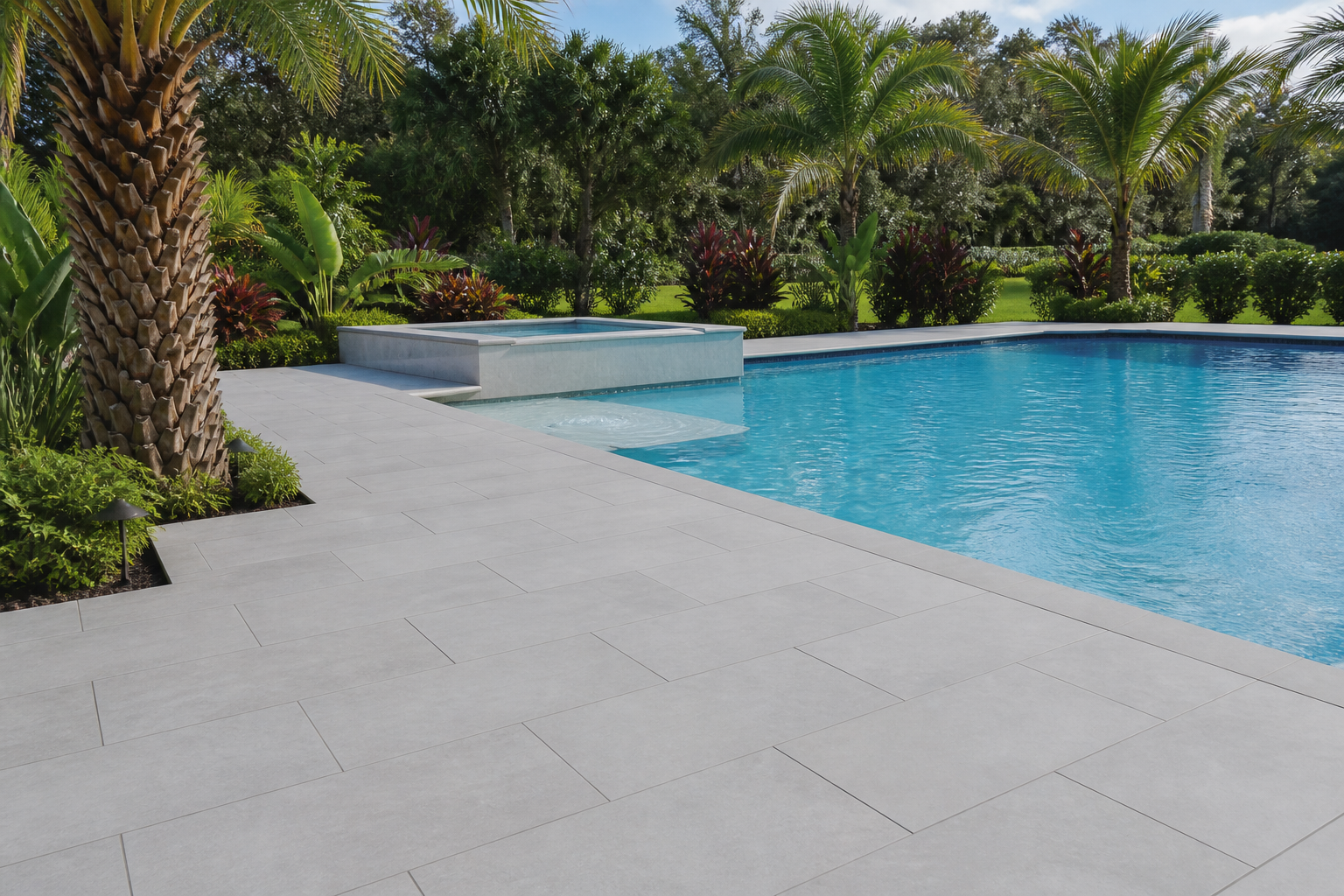
Pool deck. Lanai. Patio. If any of those are part of your project, or you just live close enough to the coast that salt air and humidity are a daily fact of life, ask a contractor directly how they think about material and installation choices for that kind of exposure. A contractor who works regularly on outdoor tile and pool-deck installations in Northeast Florida should be able to talk through how they approach layout, joint spacing, and material selection for an exterior, high-moisture setting, in plain terms.
This isn’t about getting a technical guarantee from a conversation. It’s about gauging whether the person you’re hiring has actually done this kind of work before, or whether your outdoor project would be their first. That distinction matters more here than it would for a simple interior tile job.
Getting and Comparing Estimates
Get at least three quotes before you commit. Comparing estimates side by side helps you spot outliers in both directions. A bid that’s dramatically lower than the others is as much a signal to slow down as one that’s dramatically higher (more on that in the red flags section below).
This guide isn’t the place for specific pricing. Costs vary by material, square footage, substrate condition, and project scope. Palm Coast Tile & Stone will be publishing a dedicated cost guide for tile installation in Palm Coast; check back or request a free estimate directly for numbers specific to your project.
While you’re comparing estimates, take the same interest in the details each contractor includes as you do in the bottom-line number. A usable itemized quote breaks out labor rates, a material list, the substrate-prep work involved, and an expected timeline, not just a single total. That level of detail is what actually lets you compare three quotes against each other, rather than just three numbers.
If any part of the project is a wet area, like a shower, ask directly how the contractor plans to waterproof it. Tile and grout alone aren’t waterproof; a shower needs a waterproofing system underneath, such as a membrane or waterproof backer board, to keep water out of the wall and floor assembly behind the tile. A contractor who can walk you through their waterproofing method in plain terms, rather than treating it as an afterthought folded into “sealing the grout,” is telling you something real about how carefully they build.
For projects in a specific room, our outdoor tile installation page walks through what’s involved in pool deck, lanai, and patio tile work if that’s the scope you’re comparing quotes on.
What Belongs in a Written Contract
Get it in writing. Every time. A contract worth signing should spell out:
- The full scope of work
- Materials being used, by name or specification
- Start and estimated end dates
- The payment schedule
- How change orders (any changes to scope after work starts) will be handled and priced
Standard deposit practice, according to widely cited consumer guidance, runs roughly 10 to 30 percent of the project cost upfront, with the balance due at completion. That’s a general industry norm, not a Palm Coast Tile & Stone policy statement. Ask whoever you’re weighing what their own deposit structure looks like, and get it in the contract.
Red Flags That Signal a Bad Contractor
Watch for:
- A large cash-only demand, or a request for 50 percent or more of the project cost upfront
- Pressure to sign a contract the same day you meet, especially paired with a “today-only” discount
- A contractor who asks you to pull your own building permit for work that should require one (a sign they may not be authorized to pull it themselves)
- Vague or verbal-only agreements with nothing in writing
- Refusal to provide references or answer basic questions about insurance or past work
- A bid that’s dramatically lower than every other quote you received, with no clear explanation for the gap
Any one of these on its own isn’t automatically disqualifying, but more than one together is a reason to keep looking.
What Protects You If Something Goes Wrong
Florida maintains a Homeowners’ Construction Recovery Fund, administered by DBPR, that reimburses homeowners for certain financial losses caused by a licensed contractor’s statutory violations, up to $100,000 per claim under Division I (general, building, and residential contractors) or $30,000 under Division II (specialty contractors), for contracts entered on or after July 1, 2024. One thing to know before you sign anything: this fund generally does not cover disputes with an unlicensed or exempt contractor, and given the licensing changes described above, that now describes most tile-only installers in Florida. That makes the other steps in this guide (written contract, insurance verification, references) carry more practical weight for tile projects than they might for a licensed trade.
| Division I (General/Building/Residential) | Division II (Specialty) | |
|---|---|---|
| Maximum recovery per claim | $100,000 | $30,000 |
| Applies to contracts | Entered on or after July 1, 2024 | Entered on or after July 1, 2024 |
| Covers unlicensed contractors | No | No |
Separately, Florida’s Construction Lien Law allows subcontractors, laborers, and material suppliers who aren’t in direct contract with you to file a lien against your property if they’re not paid by the general contractor, even if you already paid the GC in full. A subcontractor or supplier generally has to serve a “Notice to Owner” within 45 days of first providing labor or materials to preserve that right. This mostly matters if you’re hiring a general contractor who then subcontracts the tile work. Hiring a tile specialist directly, with no subs involved, sidesteps most of this mechanic. It’s still worth understanding if you’re weighing “hire a GC who subs out tile” against “hire a specialist directly.”
Quick Vetting Checklist
Before you sign anything, confirm you can check off all eight of these:
- You’ve seen a real, recent local portfolio of completed work, and it shows clean cuts, level surfaces without lippage, and straight, even grout lines.
- You’ve asked how the scope of work relates to Florida’s tile/stone licensing rules, and whether any part of the project (structural, electrical, plumbing) would trigger a separately licensed trade and a permit.
- You’ve seen a certificate of insurance naming you and your address, plus proof of workers’-comp coverage or a valid exemption certificate.
- You’ve asked whether the contractor holds a current local business tax receipt.
- You’ve asked about industry certification (an NTCA membership or a CTEF Certified Tile Installer credential, for example), familiarity with the TCNA Handbook and ANSI standards, and multi-year, verifiable lead-installer experience.
- You’ve gotten at least three itemized quotes that break out labor, materials, substrate prep, and timeline, and you’ve asked how any wet areas, like a shower, would be waterproofed.
- You’ve read reviews across more than one platform and checked the dates.
- You have a written contract covering scope, materials, timeline, payment schedule, and change-order terms, with a deposit in the normal 10-30 percent range, not 50 percent or more upfront.
Closing
Palm Coast Tile & Stone has been a family-owned tile, stone, and flooring contractor serving Palm Coast and the surrounding Northeast Florida area since 2007. The owner is involved from the initial estimate through the final walkthrough on every project, and the company doesn’t use subcontractors. That’s how Palm Coast Tile & Stone approaches every project, and it’s exactly what this checklist asks you to verify with any contractor you’re considering.
If you’d like to talk through a project, request a free estimate or call Palm Coast Tile & Stone at (386) 393-1166.
You can also read more about how we work on our about page.
Frequently Asked Questions
Does Florida require a license for tile or flooring installation?
Generally, no, as of a series of state law changes beginning with HB 735 in 2021 and finalized by SB 1142 in 2024, codified at Florida Statute § 163.211. Local licensing of tile, terrazzo, marble, granite, and decorative stone installation was preempted to the state, and local licenses that existed before January 1, 2021 expired July 1, 2025. This applies to the tile-setting scope itself; work that also involves structural, electrical, or plumbing changes may still require a separately licensed trade.
What’s the difference between a certified and a registered contractor in Florida?
A certified contractor holds a state certificate of competency and can work anywhere in Florida. A registered contractor holds a locally issued competency license limited to the jurisdiction that issued it. Neither category currently applies the same way to tile-only installation, given the licensing changes described above.
Do I need a permit for a tile installation project?
It depends on the scope. Permits are typically tied to structural, electrical, or plumbing work rather than cosmetic tile installed over an existing substrate, but requirements vary by project and jurisdiction. Ask your contractor directly whether your specific project requires a permit, and confirm with the local building department if you’re unsure.
What is a local business tax receipt, and should my contractor have one?
It’s a registration that most construction and home-improvement businesses need to operate in a Florida county or municipality, separate from any state trade license. In Flagler County, most contractors need a county Local Business Tax Receipt, and businesses working inside Palm Coast, Bunnell, or Flagler Beach also need the relevant municipal receipt. It’s a fair, factual question to put to whoever is bidding your job.
Is a large upfront deposit a red flag?
A deposit in the range of 10 to 30 percent of the project cost, with the balance due at completion, is standard practice according to widely cited consumer guidance. A demand for 50 percent or more upfront, especially in cash, is commonly flagged as a red flag worth asking more questions about.
How do I check if a contractor is insured?
Ask for a certificate of insurance (COI) naming you and your property address. If the crew has employees, ask for proof of workers’-compensation coverage or a valid exemption certificate if they qualify as exempt. Don’t assume a small crew is automatically compliant either way. Ask to see the documentation.
What protects me if a contractor doesn’t finish the job or a supplier doesn’t get paid?
Florida’s Homeowners’ Construction Recovery Fund can reimburse certain losses caused by a licensed contractor’s statutory violations, but it generally does not cover disputes with unlicensed or exempt contractors. Separately, Florida’s Construction Lien Law lets unpaid subcontractors or suppliers file a lien against your property even if you already paid the general contractor, which mainly matters if you’re hiring a GC who subcontracts the tile work rather than a specialist directly.
How many quotes should I get before hiring a tile contractor?
Most consumer guidance recommends getting at least a few quotes so you can compare scope, materials, and pricing side by side. A dramatically low or high bid relative to the others is worth asking about before you decide.
What is the 1/3 rule for tile?
For large-format tile (any side 15 inches or longer) set in a running-bond or brick-joint pattern, the offset between adjacent tiles generally shouldn’t exceed 1/3 (33%) of the tile’s length, per Tile Council of North America (TCNA) Handbook guidance and ANSI A108.02, unless the manufacturer specifies otherwise for that product. The limit exists because tile is allowed some warpage under the ANSI A137.1 manufacturing standard: a 50% (half-offset) layout lines up one tile’s high point with the next tile’s low point, which maximizes visible lippage, while a 33% offset keeps that mismatch smaller. Allowable lippage itself is tight under ANSI/TCNA standards: about 1/32 inch (roughly 1.75mm) between adjacent tile edges.
What is the 3-4-5 rule for tiling and why is it important?
It’s a quick way to confirm a layout is truly square before any tile gets set, based on the Pythagorean theorem. Measure 3 feet along one line and 4 feet along the line it intersects, then measure the diagonal between those two points: if that diagonal comes out to exactly 5 feet, the corner is a true 90-degree angle. Installers use this on floors, walls, and backsplashes, and it matters even more when a layout is being squared for a 45-degree or diamond tile pattern, where a slightly off corner becomes obvious across an entire room.
How do I estimate a tile job?
The most reliable approach isn’t a single walkthrough estimate; it’s collecting at least three itemized bids and comparing them line by line: labor rates, a material breakdown, the substrate-prep work involved, and an expected timeline. See “Getting and Comparing Estimates” above for what a usable itemized quote should include.
How much should I pay a tiler per day?
National data puts typical tile installation labor at roughly $4 to $15 per square foot, with about $8 per square foot common for standard 12×12 ceramic or porcelain on a flat floor, and established tile setters often billing $75 to $110 an hour depending on the metro area. Those are national averages, not a Palm Coast quote, and they move a lot based on project specifics: large-format tile commonly adds $2 to $6 per square foot, wall tile adds $1 to $4 per square foot, and specialty work like mosaics or full shower systems can run past $20 per square foot. Treat these as a sanity check, not a bid, and get a written, itemized quote from a local Flagler-area contractor for a number that actually reflects your project.